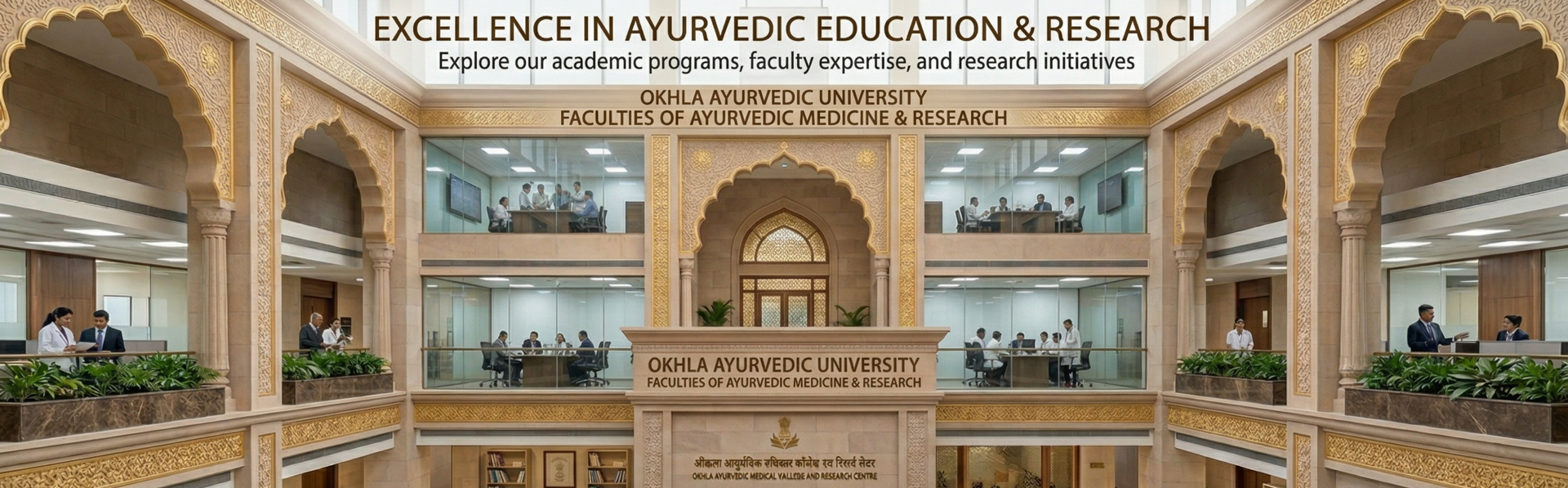
Academic programmes and departments
Competency-based Ayurveda education with integrated basic sciences, clinical departments, and community learning.
Programme philosophy
The undergraduate Ayurveda programme at OAMCRC is designed to help students interpret classical texts, apply diagnostic frameworks, prescribe safely within scope, and communicate effectively with patients and colleagues. Horizontal and vertical integration across subjects reduces fragmentation and reinforces clinical reasoning.
Formative assessments, objective structured clinical examinations where applicable, and logbook verification ensure that competencies are demonstrated—not merely memorised.
Undergraduate programme structure (illustrative)
Professional years integrate basic sciences in early phases, para-clinical subjects in middle phases, and clinical rotations with progressive responsibility in later phases. Integrated teaching blocks highlight links—for example, between Sharir Rachana, Roganidana imaging, and Kayachikitsa bedside findings.
| Phase | Emphasis | Learner expectations |
|---|---|---|
| Pre-clinical | Samhita, Sanskrit, anatomy, physiology, biochemistry foundations | Concept mastery, practical skills, early hospital orientation visits |
| Para-clinical | Pathology, pharmacology, Dravyaguna, Rasashastra laboratory work | Specimen identification, formulation principles, documentation |
| Clinical | All clinical departments including Panchakarma and surgery exposure | Case presentations, procedures under supervision, night duties as per roster |
| Internship | Consolidated clinical responsibility with graded autonomy | Competency certification, completion of logbook requirements |
Teaching–learning methods
Didactic & interactive lectures
Large-group sessions use audience response prompts, clinical vignettes, and flipped classroom readings from both classical and modern texts.
Small-group tutorials
Problem-based learning on diagnosis and management dilemmas encourages peer discussion and faculty facilitation rather than one-way delivery.
Skill laboratories
Task trainers, suturing pads, CPR manikins, and panchakarma procedure demonstrations precede supervised patient contact.
Self-directed learning is promoted through guided reading lists, open-access repositories where permissible, and departmental seminars where students present topics. Faculty provide rubrics so learners know how oral presentations will be graded.
Assessment and examination
Internal assessments include written tests, practical examinations, viva voce, and clinical evaluations. Weightages follow university regulations. Remediation schedules are offered for students who fall below passing standards in formative components.
University examinations determine eligibility for promotion to the next professional year. Supplementary examination opportunities, paper revaluation rules, and photocopy provision of answer scripts—if offered—are communicated only through official circulars.
Departmental overview
Maulik Siddhant & Samhita
Foundational Ayurvedic principles, Sanskrit competencies, and critical reading of Brihat trayi and Laghu texts. Students learn to trace clinical concepts to primary sources.
Elective exposure to commentaries and debates on controversial shlokas builds interpretive rigour without dogmatism.
Rachana & Kriya Sharir
Anatomy and physiology taught with correlation to modern biosciences and Ayurvedic dosha–dhatu–mala models for integrated understanding.
Dravyaguna Vigyan
Medicinal plants, identification, cultivation ethics, pharmacognosy basics, and rational use of herbal formulations.
Rasashastra & Bhaishajya Kalpana
Pharmaceutical preparation, quality control awareness, metal–mineral safety discourse, and good manufacturing practices orientation.
Roganidana & Vikriti Vigyan
Pathology and diagnostics bridging Ayurvedic nidana with contemporary investigations where appropriate.
Swasthavritta & Yoga
Preventive medicine, lifestyle counselling, yoga protocol literacy, and public health applications.
Agad Tantra & Vyavahara Ayurveda
Toxicology, forensic awareness, medical jurisprudence introductions, and emergency referral judgement.
Prasuti Tantra & Stri Roga
Women’s health, antenatal care within scope, collaborative referral models, and respectful maternity support.
Kaumarabhritya
Paediatric growth milestones, nutrition, immunisation coordination, and family-centred counselling.
Shalya Tantra
Surgical principles in Ayurveda, asepsis, minor procedures training, and operation theatre discipline.
Shalakya Tantra
ENT, eye, and dental domains as per Ayurvedic specialisation with referral pathways for advanced care.
Kayachikitsa
General medicine in Ayurveda, chronic disease management, integrative case discussions, and documentation standards.
Panchakarma
Purification therapies, indications–contraindications, standard operating procedures, and patient monitoring.
Students learn vitals monitoring, hydration status, and emergency cessation criteria during intensive therapies.
Each department publishes course objectives and outcomes aligned to graduate roles such as clinician, communicator, collaborator, manager, health advocate, scholar, and professional. Mapping matrices link lectures and practicals to these outcomes for accreditation readiness.
Attendance, leave, and progression
Minimum attendance percentages for theory, practical, and clinical postings follow university and regulatory stipulations. Students track attendance through registers or biometric systems where installed. Medical leave requires valid certificates; emergency leave must be regularised promptly.
Condonation rules, if any, are strictly as per university manual. Students falling short may be detained from appearing in examinations or completing internship requirements until deficits are made up through additional postings approved by the Principal.
Academic calendar
Term dates, internal assessment windows, university examination schedules, and holiday lists are issued through the Official notices channel. Students should monitor updates weekly and confirm revisions with their class coordinators.
Library and digital learning
Collections
Reference and lending sections include classical texts, modern Ayurveda and biomedical journals, dissertations, and competitive examination resources. Quiet study zones support deep reading.
E-resources
Where subscriptions exist, remote access credentials are issued to students and faculty. Information literacy sessions teach citation integrity and plagiarism avoidance.
Inter-library loan arrangements with partner institutions may be activated for rare texts subject to policy.
IT and learning management
Computer laboratories support biostatistics practicals, telemedicine orientation modules, and digital assignment submission where enabled. Cyber hygiene—strong passwords, phishing awareness, and responsible social media conduct—is part of orientation.
Faculty development
Workshops on simulation teaching, rubric design, research methodology, and ed-tech tools are scheduled each academic year. Faculty are encouraged to pursue higher qualifications, guided reading groups, and peer observation of lectures and clinics.
Financial support for conference travel, membership in professional bodies, and training in medical education technologies may be available subject to institutional policy and budget heads. Faculty presenting original research or delivering invited lectures bring credit to the college and inspire students.
Student support services
Remedial classes, peer tutoring, and counselling referrals support learners facing academic or personal stress. Career guidance cells share information on postgraduate entrances and fellowships without endorsing private coaching brands.
Hospital–college liaison
Joint academic meetings align bed availability for teaching cases, ensure duty rosters protect student rest hours, and coordinate interdepartmental referrals for complex patients.