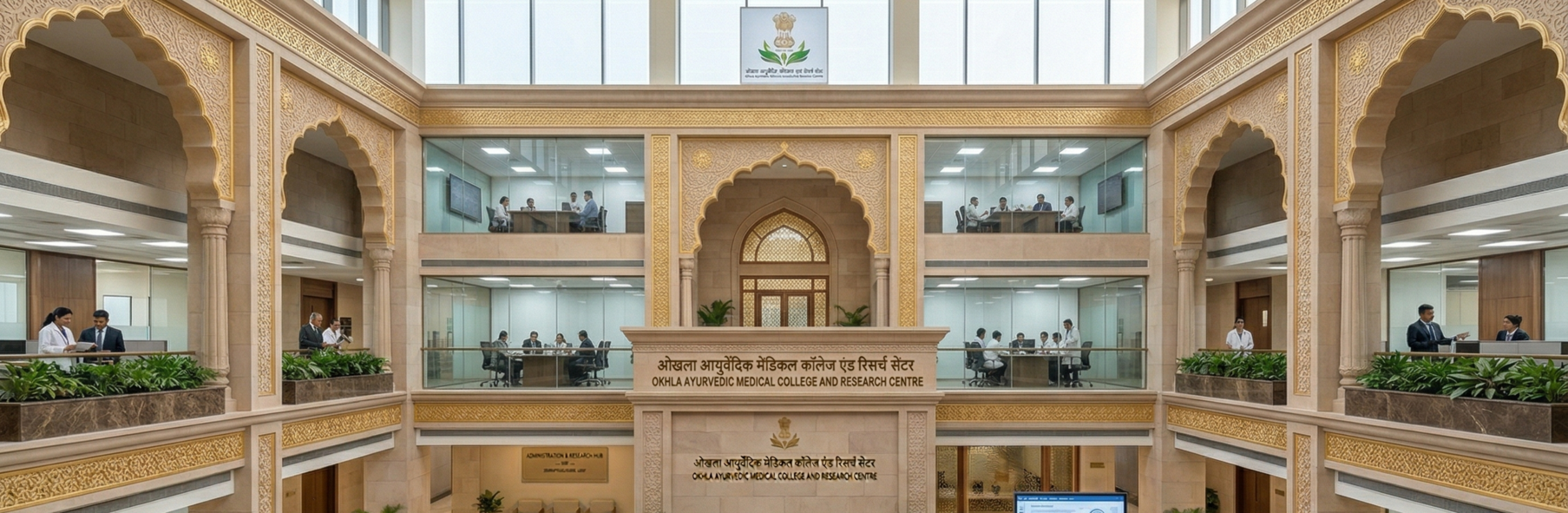
Organization and governance
Transparent leadership, statutory compliance, and academic autonomy within the framework of national medical education policy.
Institutional profile
Okhla Ayurvedic Medical College And Research Centre (OAMCRC) functions as a dedicated centre for undergraduate Ayurveda education, clinical training, and research incubation. The college situates itself within the evolving National Commission for Indian System of Medicine (NCISM) landscape and AYUSH policy priorities.
According to institutional records, OAMCRC’s foundational journey is associated with the year 2019 and national leadership emphasis on expanding AYUSH capacity. Stakeholders should corroborate establishment and affiliation particulars using gazette notifications and official letters referenced on the Official page when uploaded.
The college operates an integrated campus model linking pre-clinical teaching blocks, para-clinical laboratories, a teaching hospital or affiliated clinical sites, administrative wings, hostels (where applicable), and support services such as security, housekeeping, and engineering maintenance. Each unit reports through defined reporting officers to enable swift resolution of infrastructure and service issues.
OAMCRC’s identity as a research centre signals intent to generate publishable scholarship, mentor student projects, and participate in multicentric studies where ethics and data-sharing agreements permit. Research governance is layered through departmental research coordinators, the institutional ethics committee, and financial oversight for sanctioned grants.
Organisational hierarchy (overview)
The following description is functional rather than a substitute for organograms filed with regulators. Exact titles and reporting lines follow approved statutes and service rules.
Apex and policy level
The governing body sets policy, approves budgets, and monitors compliance. It receives periodic reports on admissions, examination results, hospital statistics, research output, and audit findings.
Executive level
The Principal leads academic and administrative implementation, supported by vice-principal or coordinators for hospital affairs, examinations, and student welfare as instituted.
Academic departments
Each department is headed by a professor or senior faculty member who manages timetables, internal assessments, practical and clinical rotas, and faculty leave planning.
Support services
Accounts, stores, estate, IT, library, and transport sections operate under administrative officers with defined financial powers and procurement policies.
Vision
To graduate Ayurvedic physicians who combine classical knowledge, scientific temperament, and compassionate care for individuals and communities.
Quality aspiration
OAMCRC envisions a learning culture where Sanskrit sources, modern biosciences, and clinical reasoning reinforce one another without compromising patient safety or professional humility.
Social responsibility
The institution commits to inclusive education, environmental mindfulness in campus operations, and service to underserved populations through outreach and public health partnerships.
Mission
- Deliver competency-based Ayurveda curricula with continuous outcome assessment.
- Strengthen hospital-linked training, simulation, and bedside teaching under qualified faculty.
- Promote ethical research, publication discipline, and interprofessional respect.
- Foster lifelong learning, digital literacy, and leadership among students and staff.
- Embed community-oriented primary care and preventive medicine in graduate attributes.
- Maintain transparent communication with parents, alumni, and regulatory inspectors.
- Invest in faculty retention, recognition, and sabbatical or training leave where rules permit.
Mission fulfilment is reviewed annually through academic audit meetings, graduate feedback, employer surveys (where feasible), and hospital partnership reviews. Corrective actions—extra remedial classes, infrastructure upgrades, or policy revisions—are documented with timelines and responsible officers.
Governance architecture
Academic and administrative decisions flow through bodies designed to uphold transparency, stakeholder voice, and regulatory compliance.
Governing board
Strategic planning, budget oversight, infrastructure expansion, and alignment with public interest are reviewed periodically. Minutes and resolutions are maintained as per norms.
Principal’s office
Day-to-day academic administration, discipline, liaison with affiliating authorities, and implementation of academic calendar decisions.
Academic council
Curriculum review, examination regulations, new programme proposals, and academic quality benchmarking.
Additional statutory and standing bodies
Board of studies (departmental)
Each department recommends syllabus updates, textbook lists, practical manuals, and assessment blueprinting in harmony with university templates.
Finance committee
Reviews fee structures (as approved by competent authority), expenditure patterns, and capital project cash flows before governing body ratification.
Building & works committee
Oversees civil maintenance, fire safety drills, lift certification, and biomedical equipment calibration schedules.
Admission committee
Implements central or state counselling outcomes, verifies document authenticity, and publishes merit lists as per public notice.
Key committees
| Committee | Mandate |
|---|---|
| Anti-ragging committee | Prevention, awareness, prompt redressal, and liaison with statutory portals. |
| Internal complaint committee | Gender sensitisation and grievance handling as per applicable law and institutional policy. |
| Research ethics | Review of proposals involving human participants, data privacy, and risk–benefit assessment. |
| Library advisory | Collection development, digital resources, and research support services. |
| Discipline committee | Investigates breaches of code of conduct, recommends proportionate penalties, and ensures natural justice principles. |
| SC/ST & OBC cell | Monitors reservation compliance, fellowship information, and grievance redressal for reserved category students and staff. |
| Equal opportunity cell | Facilitates inclusion for persons with disabilities and coordinates accessible formats where required. |
| Biomedical waste management committee | Audits segregation, barcoding (if applicable), tie-ups with authorised recyclers, and training logs. |
| Hospital infection control committee | Surveillance of nosocomial infections, antibiotic stewardship orientation, and outbreak response drills. |
Quality assurance mindset
While nomenclature may vary by affiliation stage, OAMCRC institutionalises internal academic audits, feedback from students and faculty, and corrective action plans. Departments maintain lesson plans, logbooks, and skill checklists to ensure traceability of competencies.
Partnerships with hospitals, laboratories, and universities are pursued to benchmark clinical exposure and research output responsibly.
Student feedback—anonymous where possible—is collected mid-term and end-term on teaching clarity, punctuality, practical organisation, and assessment fairness. Faculty receive anonymised summaries for reflection; recurring concerns trigger mentoring or workload adjustments.
Alumni tracer studies and employer feedback (for graduates placed in institutions) inform curriculum tweaks, soft-skills emphasis, and digital tool training. External peer reviews or accreditation preparatory exercises are scheduled when the institution approaches eligibility milestones.
Documentation culture
Meeting minutes, inspection compliance matrices, and action-taken reports are archived digitally and in print for traceability during university or council visits.
Continuous improvement
KPIs such as student:faculty ratio adherence, average library footfall, research grants secured, and patient satisfaction indices in the teaching hospital guide annual planning.