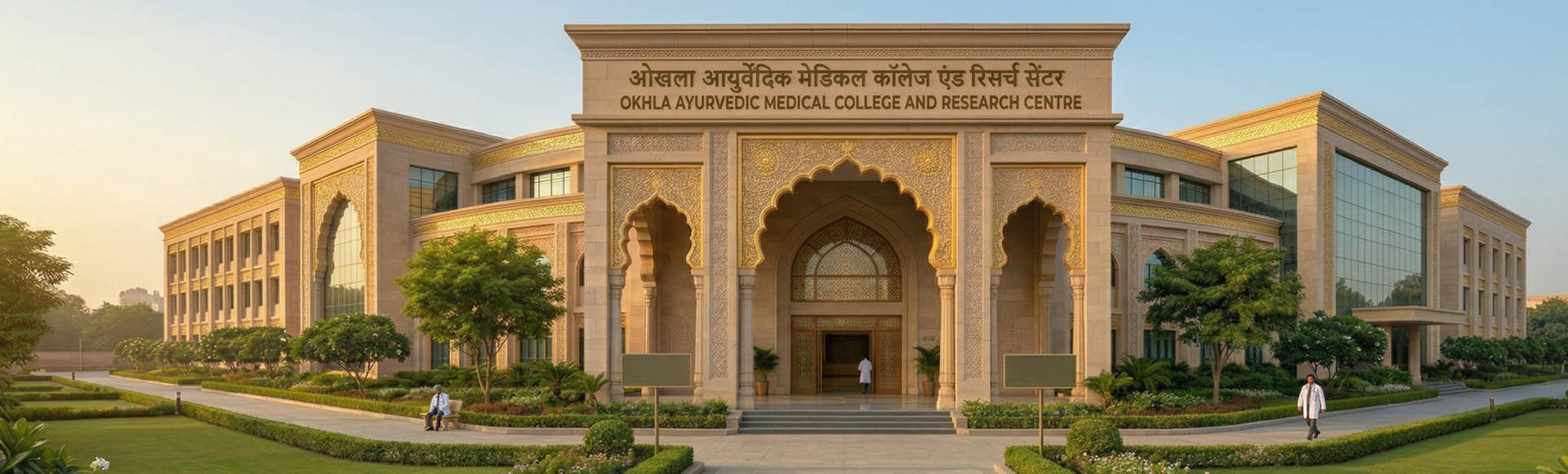
Okhla Ayurvedic Medical College And Research Centre
Integrating classical Ayurveda with modern clinical science, ethics, and community care from Okhla Phase 3, New Delhi.
Welcome to OAMCRC
Okhla Ayurvedic Medical College And Research Centre (OAMCRC) is committed to producing compassionate Ayurvedic physicians who can serve individuals, families, and public health systems with evidence-aware practice.
Our mandate
We nurture academic rigour in Sanskrit-based fundamentals, bedside clinical skills, and research literacy so graduates can contribute to AYUSH integration and primary care.
The institution foregrounds professional ethics, gender sensitivity, infection prevention, and respectful communication in every teaching–learning transaction.
Faculty act as role models in punctuality, documentation, consent-based examination, and transparent communication with patients and attendants.
Delhi NCR advantage
Studying in New Delhi offers exposure to diverse patient populations, referral pathways, national conferences, and collaborations with multidisciplinary hospitals and research forums.
Students are encouraged to participate in health camps, IEC activities, and yoga lifestyle promotion alongside departmental academic work.
Proximity to policy institutions, libraries, and specialty centres supports electives, observer ships, and competitive examination preparation when planned through proper channels.
As a full-fledged Ayurvedic medical college and research centre, OAMCRC emphasises competency-based medical education: defined learning outcomes, structured feedback, remediation for lagging learners, and mapping of teaching hours to graduate attributes expected by regulators and society.
Academic integrity
Plagiarism prevention, honest attendance reporting, and fair examination conduct are non-negotiable. Students receive orientation on UGC and institutional norms at the beginning of each academic year.
Patient safety culture
Universal precautions, biomedical waste segregation, hand hygiene, and escalation pathways for adverse events are practised in all clinical areas under faculty supervision.
Digital readiness
Learners use learning management tools, online journals where subscribed, and secure communication for official notices—reducing reliance on unverified social media forwards.
Establishment and vision
OAMCRC traces its journey to 2019, a milestone year when the institution was established with national leadership attention. The college continues to align its growth with statutory norms, patient safety, and academic quality.
Visitors and stakeholders are advised to verify statutory approvals, affiliations, and intake details through official notifications published on the Official section and authorised government portals.
The college situates its academic planning within the national framework for Indian System of Medicine, including graduate attribute expectations, horizontal integration of basic and clinical sciences, and vertical integration across professional years. Curriculum committees review alignment with university schemes of examination and NCISM regulations as applicable.
Stakeholders include students, parents, faculty, non-teaching staff, hospital partners, regulatory bodies, and the local community. OAMCRC maintains structured channels—suggestion boxes, class representatives, staff councils, and formal meetings—to incorporate feedback into quality improvement cycles.
Why Ayurveda matters today
Person-centred care
Ayurveda’s prakriti-based assessment encourages individualised diet, lifestyle, and therapeutic planning rather than one-size-fits-all prescriptions when applied judiciously alongside modern diagnostics.
Preventive focus
Dinacharya, ritucharya, and yoga-compatible routines support NCD prevention, stress resilience, and healthy ageing—priorities for urban populations including Delhi NCR.
Integrative pathways
With growing evidence dialogue, Ayurveda graduates trained in safety and interprofessional etiquette can contribute ethically within multidisciplinary teams.
Campus and academic highlights
Teaching departments
Foundational departments include Maulik Siddhant & Samhita, Rachana Sharir, Kriya Sharir, Dravyaguna, Rasashastra & Bhaishajya Kalpana, Roganidana, Swasthavritta & Yoga, Agad Tantra, Prasuti & Stri Roga, Kaumarabhritya, Shalya Tantra, Shalakya Tantra, Kayachikitsa, and Panchakarma—each with structured theory, practical, and clinical correlation.
Read the Academic section for department-wise objectives and learning outcomes.
Infrastructure snapshot
Auditoria, seminar halls, dissection facilities, museums, pharmacies, and skill areas are maintained to support competency-based learning. IT-enabled resources supplement traditional manuscripts and modern textbooks.
Hospital-linked training emphasises case documentation, diagnostic reasoning, emergency protocols, and medico-legal awareness.
Clinical training architecture
From early professional years, learners are introduced to hospital etiquette, case sheet writing, consent, and privacy. Progressively, they undertake supervised OPD and ward duties, night-call exposure as per norms, and specialty rotations that mirror the spectrum of Kayachikitsa, Panchakarma, Shalya, Shalakya, Stri–Prasuti, and Kaumarabhritya.
Clinical teaching uses bed-side demonstrations, topic seminars, journal clubs, and mortality–morbidity discussions where applicable. Students maintain logbooks that faculty sign after verifying competencies such as history-taking, examination manoeuvres, and procedure assistance.
Laboratories and museums
Anatomy dissection hall, physiology and biochemistry laboratories, pathology museum specimens, pharmacology demonstrations, and Dravyaguna herbarium specimens reinforce theory with tactile learning. Rasashastra laboratories stress safety protocols when handling minerals and apparatus.
Skill corners for ksharasutra, agnikarma, and basic surgical scrubbing complement simulation-based practice before live patient exposure.
Student life and holistic growth
Beyond examinations, OAMCRC encourages sports, cultural programmes, literary societies, and volunteerism so graduates remain balanced clinicians and citizens.
Mentorship
Faculty mentors track academic progress, attendance, and wellbeing referrals where needed. Anti-ragging measures and internal complaint committees operate as per norms.
Community immersion
Rural and urban health camps build communication skills, epidemiological awareness, and empathy. Students learn triage, screening, and referral under supervision.
Professional readiness
Workshops on medical ethics, digital health literacy, scientific writing, and quality improvement prepare students for higher education and workplace expectations.
Co-curricular and cultural life
Annual day, Ayurveda day celebrations, yoga demonstrations, debate and quiz competitions, and observance of public health weeks build teamwork and leadership.
Sports and wellness
Outdoor and indoor sports facilities—where available—are scheduled to avoid clash with clinical duties. Physical fitness is linked to stress management and clinician wellbeing.
Literary and Sanskrit forums
Reading circles on Charaka, Sushruta, and Vagbhata excerpts, coupled with modern commentaries, deepen language skills and philosophical grounding.
National AYUSH alignment and graduate outcomes
OAMCRC designs its programmes so graduates can register and practise as Ayurveda professionals within the statutory framework, pursue postgraduate training, enter teaching, or contribute to industry and public health.
Regulatory literacy
Students learn about Drugs and Cosmetics Act provisions relevant to Ayurveda manufacturing, advertising ethics, and telemedicine guidelines where notified—always subject to updates on official portals.
Primary care orientation
Swasthavritta, diet counselling, yoga prescription basics, and NCD screening align with national programmes on diabetes, hypertension, and anaemia control at community level.
Referral maturity
Recognising red-flag symptoms, obstetric emergencies, acute abdomen, and psychiatric crises—followed by timely referral—protects patients and reduces medico-legal risk.
The college encourages participation in Continuing Medical Education even during student years through approved external lectures, subject to attendance rules. Faculty maintain portfolios of teaching, research, and extension for appraisal and promotion as per service rules.
Career pathways after BAMS
Graduates may appear for competitive examinations for government service, join corporate wellness programmes, establish ethical clinical practice, engage in pharmaceutical quality roles, or pursue MD/MS in Ayurveda disciplines. Hospital administrative roles, health insurance medical review, and academic positions require additional experience and credentials.
OAMCRC’s counselling cell provides generic guidance on entrance examinations, portfolio building, and interview skills; however, official eligibility for any post remains defined solely by recruiting bodies and advertisements.
| Direction | Illustrative scope | Notes |
|---|---|---|
| Postgraduate Ayurveda | MD/MS in Kayachikitsa, Dravyaguna, Panchakarma, etc. | As per entrance and university rules |
| Clinical practice | OPD/IPD within registration and state regulations | Continuous professional development essential |
| Research & PhD | Pre-PhD coursework, thesis under recognised guides | Ethics clearance mandatory for human studies |
| Public health & NGOs | Programme management, training, monitoring | Often requires public health certification |
Extension, outreach, and social accountability
OAMCRC views surrounding communities as partners. Outreach teams conduct anaemia camps, school health talks on hygiene and nutrition, yoga awareness sessions for workplaces, and elder-care counselling on fall prevention and medication adherence within Ayurveda’s scope.
Faculty and students document outreach metrics—persons screened, referrals made, follow-up rates—to improve future camps. Collaborations with resident welfare associations, anganwadi workers, and ASHA networks are explored for sustainable impact.
Environmental responsibility includes tree plantation drives, plastic reduction in canteens, and safe disposal of sharps and chemicals in laboratories. The institution promotes energy conservation and rainwater harvesting where infrastructure permits.
Core values of the institution
- Compassion: Every learner is trained to listen first, examine gently, and explain treatment plans in language patients understand.
- Excellence: Continuous benchmarking against regulatory standards and peer institutions drives infrastructure and faculty development investments.
- Integrity: Honest reporting, avoidance of exploitative fee agents, and transparent examination processes protect the college’s reputation.
- Inclusion: Respect for diversity of language, faith, gender identity, and disability—with reasonable accommodations per policy.
- Innovation: Responsible adoption of technology, simulation, and research methods without diluting classical foundations.
News and upcoming events
Official dates for examinations, holidays, workshops, and guest lectures will be published through the Official notices channel.
| Indicative item | Detail | Status |
|---|---|---|
| Academic calendar | Term-wise schedule including internal assessments | See Official page |
| CME / workshop | Panchakarma and lifestyle medicine themes | To be notified |
| Health camp | Community screening in NCR collaboration | Seasonal |
| Guest lecture series | National experts on evidence-based Ayurveda and research ethics | Term-wise |
| Sports meet | Inter-batch athletics and team games | Annual |
| Library orientation | OPAC, e-journals, plagiarism tools | Beginning of year |
| Alumni interaction | Career panels and mentoring slots | On invitation |
Frequently asked questions
What programmes does OAMCRC offer?
OAMCRC focuses on undergraduate Ayurveda education aligned with NCISM and AYUSH guidelines, integrated hospital training, and research orientation across basic and clinical departments.
Where is Okhla Ayurvedic Medical College located?
The campus is located at Okhla Phase 3, New Delhi 110020. Use the Contact page for directions and the official phone number 011-373749.
How can I verify recruitment and admission notices?
Always cross-check announcements on the Official page and through authorised communication only. OAMCRC does not ask for cash deposits to personal accounts for admissions or jobs.
Does the college emphasise clinical training?
Yes. Clinical competence is central to the curriculum through hospital postings, skill labs, community outreach, and supervised patient care under faculty guidance.
What research areas are promoted at OAMCRC?
Research spans dravyaguna, rasashastra, kayachikitsa, panchakarma, literary research, and evidence-informed clinical studies subject to ethics clearance.
What is the attendance and discipline policy?
Regular attendance in theory, practical, and clinical postings is mandatory as per university and regulatory norms. Leave requires prior approval except in emergencies, with documentary evidence. Ragging is strictly prohibited and punishable under law.
Does OAMCRC support students preparing for PG entrance?
Departments may organise revision modules and mock tests subject to academic calendar availability. Students should rely on official syllabi of respective entrance examinations and avoid unverified coaching claims.
How does the college handle student grievances?
Grievances related to academics, examination, infrastructure, or interpersonal issues can be raised through class representatives, mentors, or designated committees as per institutional policy. Sensitive matters are handled confidentially within legal mandates.